Why I will be voting to REMAIN in Europe

The most important issue of my, my children, and their childrens’ generations and I can’t stand listening to the politicians anymore – claim and rebuttal, distortion and division – it does none of them any credit. I do however accept and welcome the fact that if every leader of all the serious political parties say it is beneficial for the UK to stay in Europe – we should stay IN. If every serious economic body (including the Bank of England, not to mention the behaviour of the London Stock Exchange) says it would put our economy at risk if we left the EU – we should REMAIN.

Economic

But it is not these people and bodies that convince me, and always has, that we are an integral part of Europe, and should have been ever since the end of WWII. For me it’s a personal and philosophical thing that transcends any national identity or sovereignty – after all I’m English-born, half-Scots, and have lived in Wales for most of my life.

With devolved governments in Scotland, Wales and Northern Ireland – all of whom recognise the importance of staying IN – this to me becomes essentially an England problem, just like the lack of an English parliament is an England created problem. They like to believe that the UK is homogeneous – that everyone is just like them. They aren’t. The nations of the UK are different and will increasingly be more different , and do you know what – it doesn’t matter, we are able to accommodate our differences … well most of the time. A Brexit vote however will only lead to a break-up of the UK with Wales surely following Scotland in calls for independence and for their application for membership of the EU as new sovereign states.

It was however this post on Facebook from a person who I don’t know (Geoffrey White) on May 18th that put my feelings into words, which I will include here  – I hope (if he ever reads this) he won’t mind me quoting his very eloquent testament …

“Some of my friends and relations have told me they will vote for Brexit in our referendum. At the risk of falling out with them I intend to vote for us to remain in the EU. Here’s a bit of pre-EU history to help explain my position.

I grew up in a time of post-war austerity. My country, the United Kingdom of Great Britain and Northern Ireland, was broke and virtually in ruins. Germans were still “the enemy” in children’s games. Bomb sites and abandoned air-raid shelters were our playgrounds. Nine years after the war ended butter, meat and sugar were still rationed. One couldn’t buy sweets without coupons issued by the government.

Portugal and Spain were fascist dictatorships. In Spain unauthorised gatherings of more than 3 people were illegal. A military junta later seized power in Greece. Half of Europe was sealed off behind the Iron Curtain. I remember lying in bed at night, in my parents home, and hearing the roar of American warplanes flying overhead on their Cold War missions. We were told that, if the Russians unleashed their missiles, we would get 4 minutes’ warning of Armageddon.

In Britain our currency was weak. We had exchange controls. Travellers were allowed to take only £25 sterling out of the country plus a limited amount in foreign currency. On return, any left over had to be sold back to an authorised trader. The details were entered in one’s passport.

The UK still had the death penalty despite some obvious and irreversible miscarriages of justice. In France they still executed condemned prisoners by cutting their heads off. In Spain they used strangulation.

The press and the BBC, (there was only the BBC), were not free from government interference and books, films and plays were censored. Women were paid less than men for equivalent work and landlords could turn away black and Irish people with impunity. For private acts of “gross indecency” gay men were sent to prison.

During the 1950s, six similarly devastated European countries were determined that the catastrophe of war between them should never be repeated. They decided to work towards creating a single European economy. The result was never “just a trading agreement” as some detractors now suggest. The Treaty of Rome, signed in 1957, provided for free movement of goods, services, people and capital, with the stated aim of “closer relations between the States”.

The UK was invited to participate from the outset, but Prime Minister Attlee rather scornfully declined, thus missing the opportunity to influence the future development of Europe. However, by 1961 it had become obvious that the economies of “the Six”, (France, West Germany, Italy, the Netherlands, Belgium and Luxembourg), were growing faster than ours, so we applied to join. It took 9 years of negotiations, (and 2 vetoes), before terms were agreed. The United Kingdom officially joined the European Communities on 1st January 1973.

In the 1980s many of our skilled workers took advantage of the free movement of people and migrated to West Germany, whose economy had already overtaken ours. These British ” migrants” were the inspiration for a popular television series, “Auf Wiedersehen, Pet”.

Since 1945 there have been wars in Europe, but none between countries that were members of the European Union. Despite global economic storms, the EU’s citizens in 28 independent countries enjoy greater prosperity and greater freedom of movement, freedom from discrimination, freedom from conflict, freedom to trade across borders and freedom of expression than at any time in history.

So far no member state has ever applied to leave the EU. There have always been candidates to join but to succeed they must have democracy, the rule of law, a market economy and guarantees for the protection of minorities and human rights. They also need the support of ALL existing members, including us, without which they cannot join. In my opinion it would be a shame if Britain were to turn its back on Europe, give up its voice and influence, and opt for an uncertain future. So…I shall vote IN on 23rd June.”

That just about says it all for me, but I’d also add that all conflicts appear to me to be about what makes people different – the need for sovereignty, the desire to “control our own affairs”, the supreme importance of “our thoughts”, “our beliefs”, “our culture” – rather than recognising the value of the differences and working at how those differences can be accommodated  and extended to benefit everyone and how integration (where necessary) can be achieved. This in an age where globalisation has made national boundaries meaningless and where the only meaningful and hopeful way to exist is through co-operation and partnership.

A very good example (from USDAW) of such co-operation, where workers rights have been harmonised, is shown below.

what has europe

Of course there are faults in the EU, but there are many more in the UK which are UK-made, not Europe-made. We can’t blame the EU for our failed welfare system, our failed housing system, our failing health system, our failed ethnic minority integration polices and our failing town and city centres. [Just go to Europe and see what a bustling and vibrant market looks like – every day of the week with fresh food of every shape and size readily available.]

INSo my wish is to be part of a new Europe – one that we will help to fashion and change, much as we would have done if we’d been a founder member in 1961. I don’t want the departure of the UK from the EU to be the spark that sets off the departure of other states from the Union fuelled by other right-wing political party agendas and ideologies that could lead to conflict and division in the future.

I want Britain to be strong and for the British voters to say we have considered the issue and want to work in partnership with our fellow European nations, working together as equals, whilst recognising our differences and separate cultural identities and celebrating the differences and the value of being as one, as well.

Core and chore, or me and more disruptive thinking

This is the text of a post I was invited to contribute to the Institutional Web Managers Workshop (IWMW) Blog as a retrospective to a presentation that Joe gave at the Workshop in 2009.


When Joe Nicholls and I started our conversation back in 2007 on what the IT Services role should look like in the age of “disruptive technologies”, we had a vision that things were never going to be the same again. Indeed in a farewell valedictory at the Welsh Universities IT Services Gregynog Colloquium in 2010 I gave a talk entitled “So that’s it for IT Services … or is it?” after previously writing “We’re all doomed …“. Therefore when Brian invited me to reflect on the relevance of the talk “Servicing ‘Core’ and ‘Chore’” that we presented at IWMW 2009 to the institution today, it set up a whole stream of thoughts running – which have taken some time to commit to words.

First of all I’m extremely grateful for two recent posts by Derek Law (on this blog) and Martin Weller (on the Ed Techie blog) which gave me the courage to proceed when I was beginning to feel that I had no place, being now a number of years out of active institutional web and IT Services involvement, to express any views – let alone suggest they might be relevant! Apparently I’m not completely out of step.

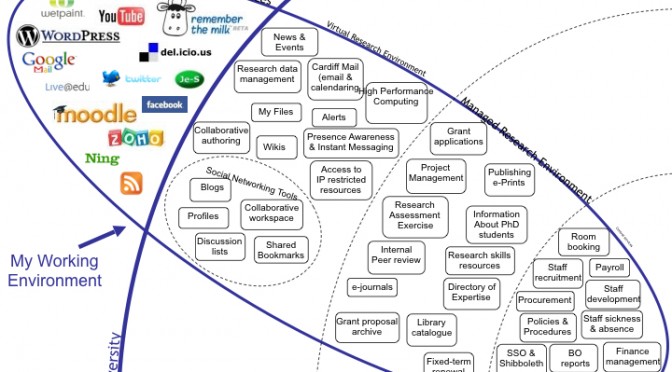
Essentially “‘Core’ and ‘Chore'” is about giving a different perspective – in fact a users perspective – on what an IT Service function needs to deliver in terms of service offering. It is an explicitly user-centric view of IT Services, as it looks to provide the user with the tools THEY require, and with the support THEY need to make full use of them. This is what we have called enablement. As a precursor to enablement, you need to go through a process of envisioning the possibilities that are available and how they might be incorporated into a users’ way of working and then engagement with the user, and as a result of following this process in partnership with the user, you aspire to deliver excellent education. We presented these ideas in a paper at Eunis 2009.

Just words I hear you say, but look at a few of the slides from Joe’s slideset and then judge the relevance to your institution today.

Core_and_Chore_6.001

The individual researcher or student has a completely different view of what they want, and need, from an IT service offering. All they require are tools and training in their use to get the educational task done. This is core to them.

Core_and_Chore_5.001

For them the interaction with corporate systems is a chore, often an unpleasant diversion from getting things done!

Core_and_Chore_7.001

This leads into a conflict because much of what the individual requires is outside the institutional firewall, and by its placement “in the cloud” is “not controllable” by the organisation. I have discussed governance and security elsewhere and previously, and don’t intend to follow that up here. Suffice to say, both issues can be resolved, through trust and education. Working in partnership. Thus we arrive at this seeming impasse …

The ‘core’ services and activities to the institution are the ‘chore’ to the individual. The ‘core’ services and activities to the individual are often not identified by the institution as necessary, or at worst are actively prevented from happening.

I would love to be able to say that I am confident that what Joe and I presented back in 2009 at IWMW has now been committed to the Room 101 of institutional web history as having been acknowledged, accepted and actioned. I fear it hasn’t. In fact I know it hasn’t as the horror stories of failed collaboration across institutions, of difficulties in migrating content into, out of and between institutions, and the failure of the very seemingly straightforward task of ensuring proper archiving of digital content is accessible outside the institution, continue seemingly in an unremitting manner.

So I conclude with just one plea for institutional web managers. I realise that you will most certainly not be in a position to alter institutional strategy, but please just please remember the individual in your service offering. Be prepared to readily provide advice on setting up a personal web presence outside the institution – that means providing advice on getting personal or project domains. Be open to the probability that researchers will want to port content out of institutional systems when they move, or retire, and have a way that enables them to do that easily. Be aware that digital content only lasts as long as it is archived properly – boring I know but time spent now will prevent tears later on. Be an envisioned and engaged web manager, enabling the user to achieve their educational objectives. Your attendance at IWMW 20, suggests that you are well on the way to doing this.