I’ve been seriously tempted to splurge some dosh on getting a Mac Mini. Without doubt, if I was starting from scratch TODAY, this is the system I would start from – alongside a Magic Keyboard and Magic Mouse.
But what specification would I choose, and what other accessories would I purchase. That’s the second part of this post.
After doing quite a bit of reading, and watching several reviews (see references at end), I have determined that for me (and I stress, for me), that the first decision that can be made is that the M4 Pro chip is way over the top for me, so that just leaves RAM and Disk Storage as a decision to make.
My MacBook Pro (2021 – M1 chip) is doing just fine, and that’s the real reason why spending money at this time is just not a sensible option, and it has 32Gb RAM. I often have several applications open at the same time when editing photos as well as Lightroom Classic – Topaz, Photoshop, Safari, and others. Having the “headroom” to know I can easily swap between them without delay (once they’re loaded) is important. So the first decision is an easy one – my MacMini should have 32Gb RAM.
The other decision to make is how much SSD storage do I need. When I purchased the MacBook Pro I imagined this would be a machine that would last me a very long-time, and so I decided that maxing up on internal storage “would be a good thing”. Wrong on a number of counts. Firstly, I really hadn’t worked out in my mind how I would use iCloud storage (I have 2.2Tb of storage – currently even in an Apple Family scenario it’s only 1.2Tb “full”). Secondly I had no sight of the incredible innovation in offline fast SSD disks, including those using NVMe technology (more later).
I recently purchased this 1Tb external SSD from Crucial for c.£99 – it does read/write at incredible speeds of 2,100 MB/s – certainly fast enough to read or write an image bearing in mind that my fast SD cards only r/w at 300MB/s. So having a large amount of internal SSD storage now doesn’t seem so essential – especially given Apple’s insanely high upgrade costs. So instead of the 2TB of internal storage (I must have been mad!) in the MacBook Pro, I think 512Gb SSD would be ample.
So we would have this Mac Mini, 2024 costing TODAY from Apple – £1199
Apple M4 chip with 10‑core CPU, 10‑core GPU, 16‑core Neural Engine
32GB unified memory
512GB SSD storage
Gigabit Ethernet
Three Thunderbolt 4 ports, HDMI port, two USB‑C ports, headphone jack
If I wanted to save cash, I would drop the SSD to 256Gb and save £200.
The next piece of kit I’d need would be a monitor. What do I particularly require? Good colour reproduction comes top of the list, with Adobe RGB compatibility as a possibility, Thunderbolt connectivity (better than HDMI for working with the Mac systems) and a good working relationship with Mac hardware.
Although the Dell Ultrasharp range would be a very sound choice, as would monitors from Asus, I’ve been very happy with the BenQ monitor I purchased to work with the MacBook Pro as a desktop system, so I would stick with them and with Wex Photovideo who I purchased the monitor from. Some in the range have a specific M-mode to ensure the best mirroring from a MacBook display. It makes sense to get that compatibility if available, even with the Mac Mini.
The monitor I have is the BenQ PD2725U 27 inch 4K UHD Thunderbolt 3 Monitor and it cost me then £899; the price has now dropped to £698 (on Amazon). However there are other BenQ monitors in the range and you can explore the BenQ and Wex Photovideo sites to see the current ranges and see prices on Amazon. You might also take a glance at this one – the MA 270U – which has a good review, or this one – the SW242Q (if you want a 24″ monitor).
So you have the Mac Mini, a monitor, keyboard and mouse, what else? Well although the MacMini is well equipped with ports, none of them are USB-A ports, and there’s no SD-Card slot – two deficiencies that I would have to rectify.
I can do that in one of two ways. I could use a docking station like the one I use with the MacBook Pro – the CalDigit Thunderbolt 4 Element Hub – which is just great (but currently unavailable but look at any in the range from CalDigit, Sabrent, OWC or UGREEN), or an alternative which is in many ways much more aesthetically pleasing (ie tidy) – a MacMini Hub, of which there a couple, but take a look at this one – I love it!
There are others on Amazon. None of them are Thunderbolt 3/4 yet, so I might wait a bit – they will be more expensive when they arrive, but could be worth the wait, because you can install that NVMe SSD RAM in them – a really cost-saving move for more storage. [Even if you can’t wait and have run out of storage, this Hub should be a good purchase – but it doesn’t appear to be available yet in the UK.]
The alternative is to buy an NVMe Enclosure and put a SSD NVMe card (from Crucial or Samsung) in it and hook it up to the MacMini directly. That’s a really earth-shattering and cheaper alternative to Apple storage, but again make sure you’re looking at 40GB/s transfer or Thunderbolt 3/4. I can recommend UGREEN kit.
Video Reviews of Mac Mini
The last one almost echoes my thoughts, but I think her original decision to go with 24Gb RAM on the MacBook Pro, was wrong!!
The only tool you need is a Posidrive #0 screwdriver for this laptop, I bought a set of six small screwdrivers made by Black & Decker some time ago; if you’re going to do more of this sort of thing, you might need to buy a more sophisticated toolset. I also attached an earth strap – just to show you how to the job properly – but to be perfectly honest I don’t usually bother.
But I’m jumping ahead. You first have to find out what upgrades you can do to your PC. I recommend using Crucial as the supplier of both RAM and hard disk upgrades. When you land on the site, you will see a screen something like this – it will change as new products are introduced …
… you click on Select Computer (you can download a tool to scan your computer, but that shouldn’t be necessary as all the information you need is usually on the bottom of the laptop) and supply the information required about your computer …
… and the following information should come up.
I’ve selected the Upgrade I want, but I’m also offered different DRAM memory choices, as well as SDD hard disk upgrades …
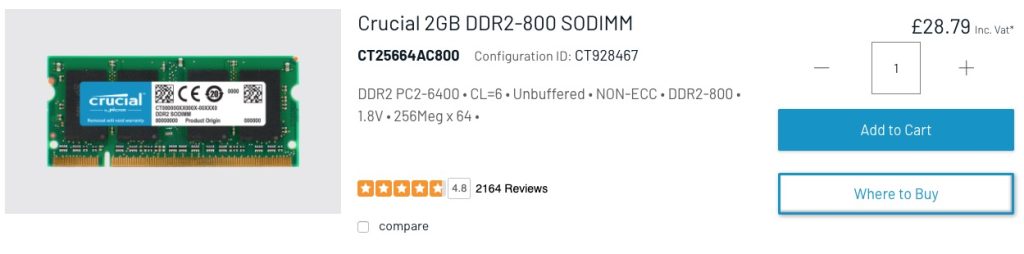
… from this I get the Part No. and then see if I can purchase it cheaper on Amazon – for old memory I usually can …
… so that’s saved £10. Now we turn to the removal of the old 1Gb DRAM module and the insertion of the new 2Gb module. Turn the laptop so that it’s back is facing upwards …
… take your screwdriver and unscrew the screws which are holding the back panel in place.
On this model the screws don’t totally come away from the panel which is great as there’s less likelihood of losing any of them. Unscrew them all, and slide the panel off …
… the DRAM is right in front of you on the left-hand side of this picture. All laptops have different layouts, but the DRAM modules are very easy to pick out! Next comes the first tricky bit (not really). You need to prise the two clips holding the module in place on either side of it. Here’s me prising one clip away …
… you have to do them together of course, but as I don’t have three hands … the module will pop out and swing upwards so that you can easily remove it, which you should do and place it on an electrically inert surface – just in case you have to put it back! You then get your new module and slip it into the space vacated by the old one at an angle. [My apologies – I should have taken a picture of this.] Most problems occur at this point as it can be tricky to insert the new module in firmly enough. You then gently push it down so that the clips re-engage with the module.
Nearly finished now. The new DRAM module is in place and you just have to replace the back panel, tighten the screws and hope that the new memory will be recognised when you boot-up the computer. You may be advised that the Memory Configuration has changed when you re-boot, just ignore this the first time you attempt to re-boot your computer. Check the memory has been recognised from the Windows System Panel …
… and you’re good to go. Any problems, first try and check the module has been inserted firmly and far enough into the slot, and then if necessary run the System Configurator when asked to when you boot up. I’ve never had to do the latter, I have had to unscrew the panel and re-insert the memory module though.
And that’s it. It took me about 10mins, but I have done it before. Still 30mins tops will see you with more memory in your old laptop and hopefully improved performance.