This post was first written for the Cardiff u3a Digital Matters group, and is copied here as it possibly has wider interest (??).
Updated 6th September 2024
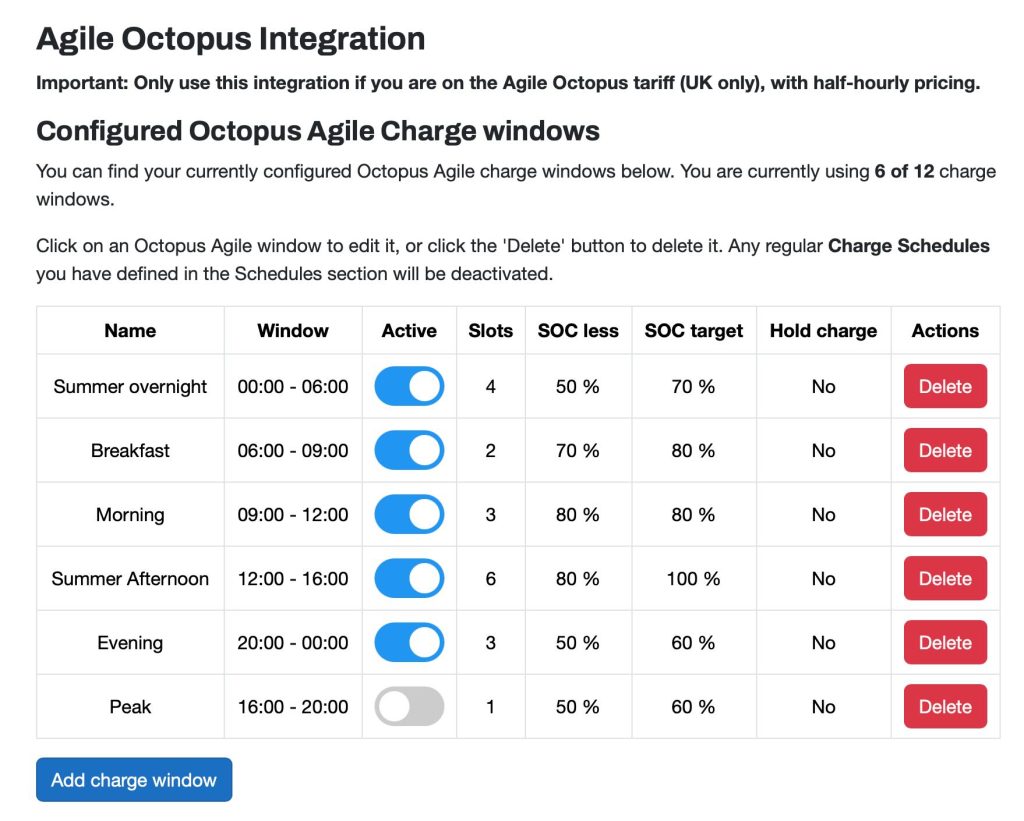
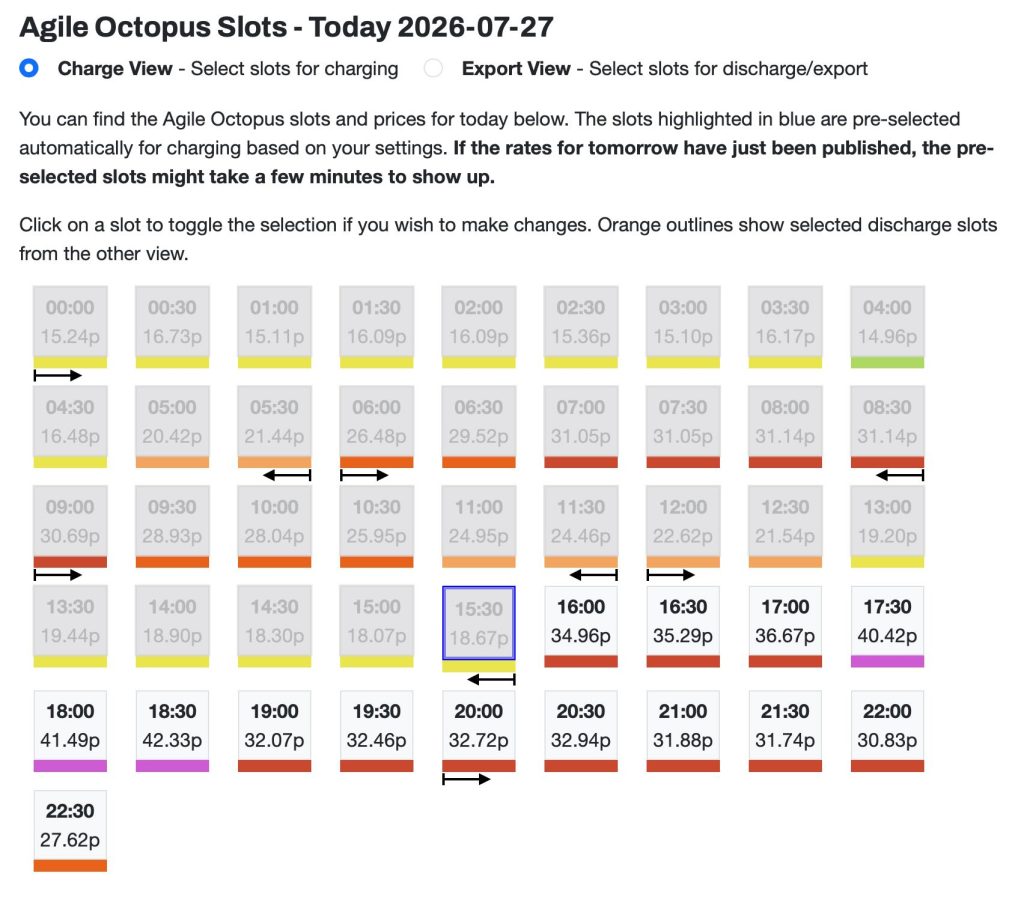
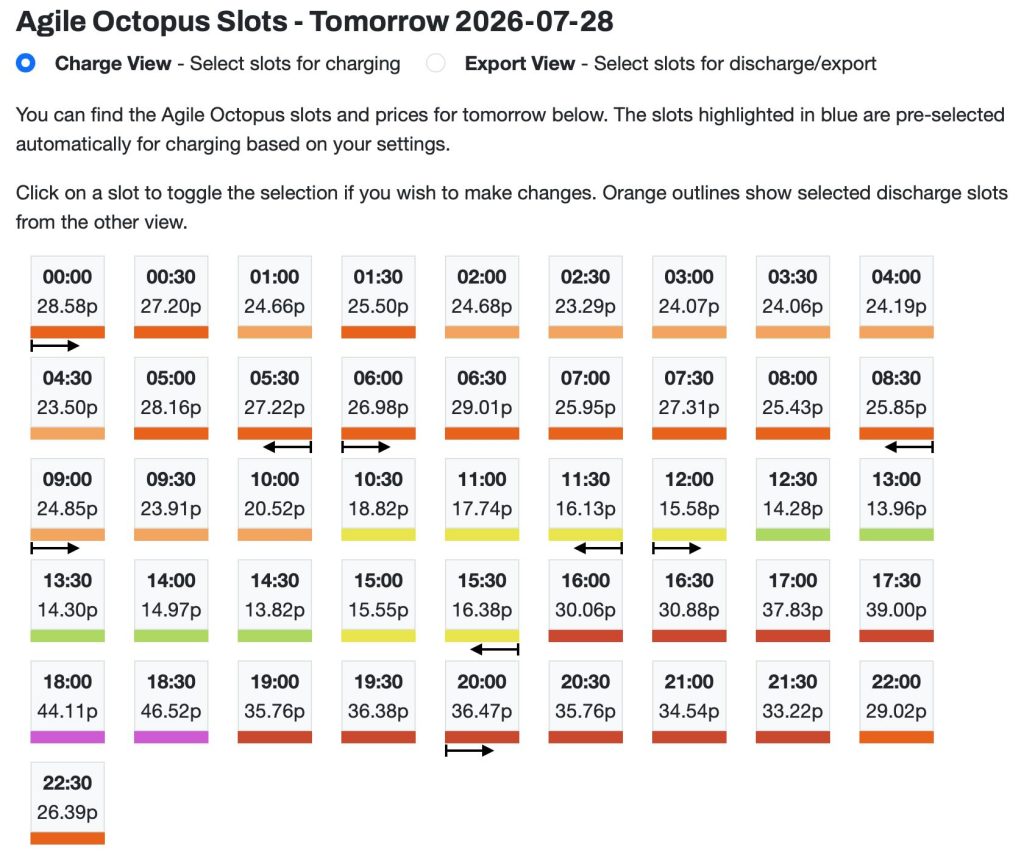
A further update to comment upon our experience with Intelligent Octopus Flux. The change to the tariff went smoothly enough; the extraction from it to change to another one didn’t go smoothly, although I can’t fault the support from Octopus – just the documentation they had to follow to enable a move off the tariff. After a few weeks on Intelligent Octopus Flux, it became apparent that it might well be a good tariff for the winter (and for anyone not wanting to actively manage their solar and battery), but not necessarily for the summer when our solar power generation was at its optimum level. I won’t go into details – maybe another post sometime – but we moved on to Agile Octopus for Import and Fixed Octopus for Export, which enabled us to take advantage of both “plunge pricing”, and also allowed us to choose when to charge up the battery from the grid, and to what level. [This takes about 2mins each day after 16:00 when the pricing for the following day becomes available using this website – which gives the pricing of electricity from the grid region by region.] In summary, Intelligent Octopus Flux appears to maximise the benefit to Octopus by allowing them to use your battery for off-grid storage, and not enable the maximum charging of your battery. Good for the planet, but not necessarily good for the consumer with an investment in solar panels and battery.
Updated 18th July 2024
This post to accompany the presentation on 11th July could be sub-titled “The data driven house”; but most certainly not “The smart house” – it would be along-time before our early-Edwardian semi could even begin to compete in that category. However, over the last year we have move significantly to reduce our carbon footprint and I believe saved quite a lot of money off our household bills – at the expense it has to be said of a reduction in our capital. Spending the kids Inheritance so-to-speak, but with their full support and encouragement. So here goes …
A brief history of our energy in days gone by.
We’ve tried over the years to switch suppliers and have been with EDF, E-On before a long-stint with British Gas which we switched to when we got our first smart meter, partly on the promise of supplying us with a tool to monitor our energy usage in an app.
However the smart meter they supplied us with was a SMETS-1 one which was soon after our installation replaced in the national rollout by a SMETS-2 version – but not given to existing customers. We were assured that British Gas was working with the regulators to ensure compatibility which would also allow users to switch providers seamlessly – but this never happened. Whilst other suppliers (eg Octopus) have found a way of jury-rigging SMETS-1 meters to work with their smart tariffs, British Gas have done nothing. In fact our experience was even worse because after a period of time (perhaps a couple of years) the app ceased giving usage information to us. We pursued them for at least 18 months but eventually – disgusted with their lack of customer service and inability to respond to enquiries first, and then complaints, we decided we should move suppliers. Family members had already chosen Ovo, and Octopus, and on their experience and after substantial review and research, and also following the recommendation from Which? we chose to switch to Octopus using our existing SMETS-1 meter – with the assurance that we could, and would, be upgraded to the SMETS-2 system in due course. This meant initially we would have no monitoring locally, but we would have access to their excellent website to monitor our usage. We had to take quite a few meter readings during the switch-over period – presumably whilst they got their systems talking to our SMETS-1 meter -but we did the switch and joined their standard Octopus Flexible tariff.
Around about the same time we got confirmation that we would have to tackle the heating of the kitchen as Jenny had a confirmed diagnosis of a health issue that meant we would have to ensure the house was much warmer than it had been in previous years. [We have been extraordinarily fortunate that last winter must have been one of the mildest on record.] So we (or Jenny to be accurate) set about getting draft excluders, heavier lined curtains, the purchase of Chimney Sheep draft excluders, replacement of double glazing with triple glazing in the main rooms Jenny used, enhancement of the insulation in the space above the kitchen extension and … upgrading of the heating in the kitchen and garden room using Infra-red Panels.
These we researched on the recommendation of a friend who has started progressively to replace all the traditional gas-heated water-filled radiators in their house with IR panels.
We visited Herschel in Bristol. We were hugely impressed at the rapid and effective performance of the panels, the fact they could be mounted on the ceilings, or walls, or standalone, and that some could have pictures or even mirrors on them, and also the low power draw and the fact they could be controlled as smart devices. Herschel provided us with an estimate of the requirement to meet our needs. We asked them to provide details of a local approved installer, who we contacted (TEG) and who then came to do a site visit. They proposed a larger pair of panels than Herschel had suggested and furthermore suggested also fitting an IR unit in the garden room, which has not been used as yet, but it was logical to install it at the same time – future-proofing the back of the house in its heating needs..
The installer mentioned that he could provide good pricing on Solar panels and batteries and VAT-free panels if done as one installation. [It also has to be added that he was able to get the panels at discount from Herschel, so although the units could be installed by any competent electrician (or even me!) the purchase of the units was cheaper than if we had ordered direct.] We had experience soft-pressure from the family to “do something green” – so went for it realising that we could never recover the installation costs in our lifetime but we could reduce our usage costs which were heading towards £3,600 (British Gas) in our old Edwardian house and likely to go higher.
At this time I also researched whether an air source heat pump might be a good idea but determined that given the generally poor insulation of our old house, such a solution would not be a great idea, but that a gradual replacement (as my friend was doing) of replacing radiators with IR panels when a room was being decorated was the better way to go.
The installation of the IR panels, the solar panels and the battery was very professional and they followed my preference for siting of cable routing and units so that it was very difficult to see what had been done. The after-sales support, warranty and documentation they provided was excellent, and it’s comforting to know that Craig is just a WhatsApp call away and can monitor our system and make changes as necessary.
When we had committed to the installation I also started pressuring Octopus to provide us with a SMETS-2 meter so that we could benefit from Smart Tariffs. They responded in a reasonable time (I suppose given the backlog of their work), but after continual pressure, the electric and gas meters were replaced, and we had new meters and the mini-hub – which allows the meters to communicate with the app on the smart phone/tablet – in place by late-October following a September installation of the solar panels and battery. Now the fun could really start!
Choice of tariff
Octopus has many, many tariffs. It would be impossible to go through them here, but be advised that if you have an EV (electric vehicle), or a heat pump, there are tariffs for you. They also provide tools to help you decide which tariff is the right one for you. We however were only interested in those that worked best with our solar panels and battery. The obvious one for us to start with was Octopus Flux. This had the benefit of allowing us to charge our battery up to its maximum for a very low rate between 02:00 and 05:00 and enable us to discharge from the batter gradually through the day whilst with the management of the GivEnergy battery we could ensure that there was a full battery for the hours of 16:00 to 19:00. It also ensured that the battery was full when we most wanted heat from the IR panels so we set them to kick-in at 04:00 in the morning and with scheduled time periods arranged for them to be on (subject to the temperature not exceeding the threshold) when we needed them on.
Monitoring, reduction in monthly direct debit
I started an intensive monitoring of our electricity usage, changing the various settings possible on the GivEnergy Dashboard
I won’t detail the experiments and changes I tried. Suffice to say it educated me about how the system could work and what I needed to consider to get optimum benefit from the system/installation. I was also very soon able to reduce the monthly direct debit that we were paying to Octopus from the initial figure they suggested (when on the standard Flexible tariff – which in itself was less than the £300 that BG had wanted from us) to now £200 a month – and we’re over £600 in credit at the moment. So an immediate 33% reduction in our energy costs – but it could be more!!!
Octopus Flux pays you when your system exports to the grid. The payment you get is less than the amount you’re paying for the import of power into the household. Last year Octopus introduced a tariff that was the same for import and export, which meant that charging the battery at a fixed time no longer was necessary and that you could get a higher payback for export during the grid high-demand period of 16:00 to 19:00. So it seemed a tariff I should try out.
We’ve been on this tariff now since May and I have had some issues with understanding how exactly it works, but essentially you’re letting your battery be controlled by Octopus and become part of the National Grid. I don’t have any difficulties with that after learning that the grid is just one huge battery effectively and that the cable that feeds your house doesn’t effectively belong to anyone except the National Grid (or its surrogates). However I’m having a dialogue with them currently on the range of battery charging/discharging they’re deploying and whether it’s too narrow. When I was on Octopus Flux I was charging the battery to 100% between 02:00 and 05:00, or something less if there was a lot of sun expected in the day, and discharging down to as low as 4%. Currently Intelligent Octopus Flux appears to be only operating in a range of 55% to 77%. I’m asking them why??
The upshot of this is that if you’re prepared to be an active battery monitor, it might be worthwhile to be on Octopus Flux, if you’re passive (or just want to save the planet), then Intelligent Octopus Flux is the one for you. I suspect a combination is best for us with Octopus Flux in the winter 6 months, and Intelligent Octopus Flux in the summer 6 months. Especially if I can combine it with smart monitoring for the winter months. Watch this space!!
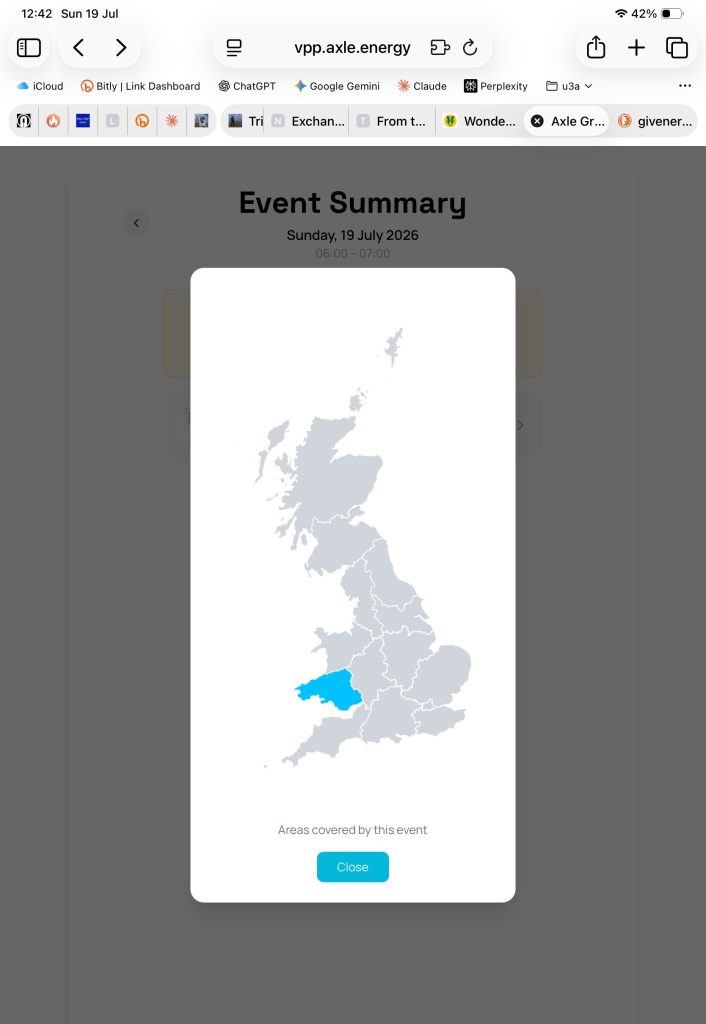
For completeness, the screens from the various apps I’m using …
Update – 18th July 2024
In the meeting I mentioned that we were having some outstanding issues in respect of the Tariff we had decided to move on to – this was a move from Octopus Flux (import and export) to Intelligent Octopus Flux. This move just didn’t work for us. We had to give up control of our battery to Octopus and it began to emerge that they were manipulating the settings to maximise operational benefits for themselves. We might have got some small financial benefit over standard tariffs, but not really very significant ones.
We’ve now changed to Agile Octopus for Import and Octopus Fixed (12m) for Export. As we don’t really want to export energy, but maximise the use of our battery, this makes much more sense. The very low Import rates on Agile we can utilise to charge our battery – something which wasn’t happening the way we’d wanted it to on the other tariffs.
So hopefully a closed chapter – I’ll of course update you on any subsequent developments.